Writing Formal Emails in French: Structure and Phrases

French formal emails follow stricter conventions than their English equivalents — the greeting, the opening sentence, the closing phrase and the sign-off each have an expected form, and deviating from them can make an otherwise well-written email feel out of place. Whether you are contacting a company, applying for a job, writing to a professor or reaching out to a client, getting the structure right is just as important as getting the message right. This guide covers everything you need: vocabulary, phrases, a full example and a reusable template.

Writing Formal Emails in French

French formal emails are more structured than English ones — and that structure is expected. Knowing the right phrase for each stage of the email lets you write confidently and correctly in any professional or academic context. If you want to practise speaking these phrases aloud, try pronunciation practice and guided conversations with Kippy. For broader professional French vocabulary, the conversational French phrases guide is a useful companion.

Essential French Words for Formal Emails

Before you start writing, it helps to have the core email vocabulary in place. These are the terms you will encounter repeatedly across formal French communication — in subject lines, requests, replies and file references. Learning them before you need them saves time when you are composing under pressure.

Basic French Email Vocabulary

The table below covers the essential nouns used in formal French email writing, each with a natural example sentence showing the word in a professional context.

French
courriel
English
email
Example Sentence
Je vous ai envoyé un courriel ce matin.
Translation
I sent you an email this morning.
French
objet
English
subject (line)
Example Sentence
L'objet du message est la réunion de demain.
Translation
The subject of the message is tomorrow's meeting.
French
pièce jointe
English
attachment
Example Sentence
Veuillez trouver la pièce jointe.
Translation
Please find the attachment.
French
réponse
English
reply
Example Sentence
Merci pour votre réponse rapide.
Translation
Thank you for your quick reply.
French
demande
English
request
Example Sentence
J'ai une demande importante à vous soumettre.
Translation
I have an important request to submit to you.
French
information
English
information
Example Sentence
Je voudrais obtenir plus d'informations sur ce sujet.
Translation
I would like to obtain more information on this subject.
French
destinataire
English
recipient
Example Sentence
Veuillez vérifier le destinataire avant d'envoyer.
Translation
Please check the recipient before sending.
French
expéditeur
English
sender
Example Sentence
L'expéditeur n'est pas reconnu.
Translation
The sender is not recognised.
French
convocation
English
invitation / notice
Example Sentence
J'ai reçu une convocation pour une réunion.
Translation
I received a notice for a meeting.
French
accusé de réception
English
acknowledgement of receipt
Example Sentence
Merci de confirmer par accusé de réception.
Translation
Please confirm with an acknowledgement of receipt.

Structure of a Formal Email in French

French formal emails follow a strict, predictable structure. Each section has an expected function and an expected register — using the right phrase in the right place signals that you understand French professional communication norms. Skipping a section or using casual language in a formal slot is one of the most common mistakes non-native writers make. The five-part structure below applies to almost every formal email, from a business enquiry to a job application to a message to a professor.

Formal Email Structure Overview

The table below shows each section of a formal French email with a standard French example and its English equivalent, so you can see exactly what goes where.

Email Section
Greeting
French Example
Madame, Monsieur,
Translation
Dear Sir or Madam,
Email Section
Opening line
French Example
Je vous écris pour…
Translation
I am writing to…
Email Section
Main message
French Example
Je souhaiterais obtenir…
Translation
I would like to obtain…
Email Section
Attachment (if needed)
French Example
Veuillez trouver ci-joint…
Translation
Please find attached…
Email Section
Closing sentence
French Example
Dans l'attente de votre réponse, je vous remercie.
Translation
Awaiting your reply, thank you.
Email Section
Sign-off
French Example
Cordialement,
Translation
Kind regards,

Formal Email Greetings in French

The greeting in a French formal email is more than a pleasantry — it signals the level of formality for everything that follows. The most important rule is that you never start a formal French email with Bonjour in a first contact with someone you do not know. Madame, Monsieur is the safest default when you do not know the recipient’s name or gender. If you do know their name, use Madame or Monsieur followed by their surname alone — never their first name in a formal email.

French Email Greetings

The table below covers the most commonly used formal French email greetings, from the most formal to slightly more approachable, with an example sentence showing each one extended into a full opening line.

French Greeting
Madame,
English Meaning
Madam,
Example Sentence
Madame, je vous écris concernant votre annonce.
Translation
Madam, I am writing regarding your advertisement.
French Greeting
Monsieur,
English Meaning
Sir,
Example Sentence
Monsieur, je vous remercie de votre retour.
Translation
Sir, thank you for your feedback.
French Greeting
Madame, Monsieur,
English Meaning
Dear Sir or Madam,
Example Sentence
Madame, Monsieur, je vous contacte au sujet de votre offre.
Translation
Dear Sir or Madam, I am contacting you regarding your offer.
French Greeting
Madame la Directrice,
English Meaning
Dear Director (f),
Example Sentence
Madame la Directrice, je me permets de vous écrire.
Translation
Dear Director, I am taking the liberty of writing to you.
French Greeting
Monsieur le Professeur,
English Meaning
Dear Professor,
Example Sentence
Monsieur le Professeur, je vous écris au sujet de mon mémoire.
Translation
Dear Professor, I am writing regarding my thesis.
French Greeting
Bonjour,
English Meaning
Hello, (semi-formal)
Example Sentence
Bonjour, je vous écris pour faire suite à notre échange.
Translation
Hello, I am writing to follow up on our exchange.

Starting a Formal Email in French

After your greeting, the opening sentence has one job: to state clearly and immediately why you are writing. French formal emails are direct in this regard — there is no small talk or scene-setting before the reason for contact. The most natural and widely expected opener is Je vous écris pour… (I am writing to…), followed immediately by the purpose. Use the conditional form je souhaiterais (I would like) rather than je veux (I want) — the conditional is standard in professional requests.

Opening Email Phrases

The phrases below are the most commonly used formal opening lines in French professional and academic email writing. Each one is direct, polite and appropriate for any first contact.

French Phrase
Je vous écris pour…
English Meaning
I am writing to…
Example Sentence
Je vous écris pour demander des informations sur vos services.
Translation
I am writing to request information about your services.
French Phrase
Je me permets de vous contacter
English Meaning
I am taking the liberty of contacting you
Example Sentence
Je me permets de vous contacter concernant le poste vacant.
Translation
I am taking the liberty of contacting you regarding the vacant position.
French Phrase
Je souhaiterais…
English Meaning
I would like to…
Example Sentence
Je souhaiterais obtenir des précisions sur ce point.
Translation
I would like to obtain clarification on this point.
French Phrase
Je vous contacte afin de…
English Meaning
I am contacting you in order to…
Example Sentence
Je vous contacte afin de confirmer notre rendez-vous.
Translation
I am contacting you in order to confirm our appointment.
French Phrase
Suite à notre conversation…
English Meaning
Following our conversation…
Example Sentence
Suite à notre conversation téléphonique, je vous envoie les détails.
Translation
Following our phone conversation, I am sending you the details.
French Phrase
Je fais suite à votre message…
English Meaning
I am following up on your message…
Example Sentence
Je fais suite à votre message du 5 mars concernant notre commande.
Translation
I am following up on your message of 5 March regarding our order.

Making Requests in a Formal French Email

Requests in formal French are always phrased in the conditional — Pourriez-vous… (Could you…) rather than Pouvez-vous (Can you), and Serait-il possible de… (Would it be possible to…) rather than any direct command. This use of the conditional is not just politeness — it is an expected grammatical marker of formal register. Using the present tense for a request in a formal email reads as abrupt or demanding, even if the message itself is reasonable. For checking that your conditional forms are correct before sending, the grammar checker tool is useful.

Request Phrases in French

The phrases below cover the standard ways to make a polite professional request in French. Use them as-is or adapt them to your specific situation — the key is to keep the conditional form throughout.

French
Pourriez-vous…
English
Could you…
Example Sentence
Pourriez-vous m'envoyer les documents avant vendredi ?
Translation
Could you send me the documents before Friday?
French
Serait-il possible de…
English
Would it be possible to…
Example Sentence
Serait-il possible de fixer une réunion la semaine prochaine ?
Translation
Would it be possible to schedule a meeting next week?
French
Je vous serais reconnaissant de…
English
I would be grateful if…
Example Sentence
Je vous serais reconnaissant de bien vouloir répondre rapidement.
Translation
I would be grateful if you could reply promptly.
French
Auriez-vous l'amabilité de…
English
Would you be so kind as to…
Example Sentence
Auriez-vous l'amabilité de me transmettre ce rapport ?
Translation
Would you be so kind as to send me this report?
French
Je vous prie de bien vouloir…
English
I kindly ask you to…
Example Sentence
Je vous prie de bien vouloir confirmer votre présence.
Translation
I kindly ask you to confirm your attendance.

Mentioning Attachments in French Emails

The French phrase for a document attached to an email is pièce jointe. The most widely used phrase for flagging an attachment is Veuillez trouver ci-joint (Please find attached) — this is the direct equivalent of the English convention and is understood in every professional French context. Always mention the attachment explicitly in the body of the email rather than relying on the recipient to notice it.

Attachment Phrases

Use the phrases below whenever you need to reference a file, report or document in your email. Each one is standard, professional and used across business, academic and administrative French communication.

French
Veuillez trouver ci-joint
English
Please find attached
Example Sentence
Veuillez trouver ci-joint le document demandé.
Translation
Please find the requested document attached.
French
Vous trouverez en pièce jointe
English
You will find attached
Example Sentence
Vous trouverez en pièce jointe le rapport complet.
Translation
You will find the full report attached.
French
Je joins à ce message
English
I attach to this message
Example Sentence
Je joins à ce message les fichiers demandés.
Translation
I attach the requested files to this message.
French
Ci-joint vous trouverez
English
Herewith you will find
Example Sentence
Ci-joint vous trouverez notre catalogue mis à jour.
Translation
Herewith you will find our updated catalogue.

Ending a Formal Email in French

The closing sentence signals that the main message is complete and invites the recipient to respond. The most common French formal closing is Dans l’attente de votre réponse (Awaiting your reply) — it is polite, direct and widely expected in professional emails. Je reste à votre disposition pour toute question (I remain available for any questions) is a strong alternative that works well when you want to signal openness rather than urgency. Always use a closing sentence before your sign-off — moving directly from the main message to the sign-off without one reads as abrupt in French professional contexts.

Email Closing Sentences

The phrases below are the most used formal closing sentences in French emails. Pair each one with the sign-off that follows for a complete, polished ending.

French
Dans l'attente de votre réponse
English
Awaiting your reply
Example Sentence
Dans l'attente de votre réponse, je vous remercie.
Translation
Awaiting your reply, thank you.
French
Je reste à votre disposition
English
I remain at your disposal
Example Sentence
Je reste à votre disposition pour toute question.
Translation
I remain available for any questions.
French
Merci pour votre attention
English
Thank you for your attention
Example Sentence
Merci pour votre attention à ce message.
Translation
Thank you for your attention to this message.
French
N'hésitez pas à me contacter
English
Do not hesitate to contact me
Example Sentence
N'hésitez pas à me contacter pour toute information complémentaire.
Translation
Do not hesitate to contact me for any additional information.
French
Je vous remercie d'avance
English
Thank you in advance
Example Sentence
Je vous remercie d'avance pour votre aide.
Translation
Thank you in advance for your help.

Formal Email Sign-Offs in French

French formal sign-offs are notably longer and more elaborate than their English equivalents. The most formal closing — used in official, legal and high-stakes professional emails — is the full formula Veuillez agréer, Madame / Monsieur, l’expression de mes salutations distinguées. For most business and professional emails, Cordialement or Bien cordialement are the standard choices and are accepted across all French-speaking professional contexts. Save Sincèrement for emails where there is an established relationship with the recipient.

French Sign-Off
Veuillez agréer, Madame, Monsieur, l'expression de mes salutations distinguées.
English Meaning
Please accept, Madam/Sir, the expression of my distinguished regards.
Formality Level
Very formal
Best Used For
Official letters, first contact with institutions
French Sign-Off
Veuillez recevoir mes cordiales salutations.
English Meaning
Please receive my cordial regards.
Formality Level
Formal
Best Used For
Business and professional first contact
French Sign-Off
Cordialement,
English Meaning
Kind regards,
Formality Level
Standard professional
Best Used For
Most business emails
French Sign-Off
Bien cordialement,
English Meaning
Best regards,
Formality Level
Warm professional
Best Used For
Clients and colleagues you know
French Sign-Off
Sincèrement,
English Meaning
Sincerely,
Formality Level
Professional
Best Used For
Established professional relationships
French Sign-Off
Respectueusement,
English Meaning
Respectfully,
Formality Level
Formal
Best Used For
Hierarchical or academic contexts

Formal Email Template in French

Use the template below as a starting point for any formal French email. Replace the bracketed sections with your specific content — keep all the structural phrases exactly as shown. Save this template in your personal phrasebook alongside your most-used phrases so it is ready whenever you need it. For checking the grammar and formality of your completed draft, the grammar checker tool helps catch conditional and agreement errors before you send.


Madame, Monsieur,

Je vous écris pour [raison du contact].

[Message principal — ce que vous demandez ou communiquez.]

[Si vous joignez un document : Veuillez trouver ci-joint [nom du document].]

Je vous remercie pour votre attention et reste dans l’attente de votre réponse. Je reste à votre disposition pour toute question.

Cordialement, [Prénom Nom]


Frequently Asked Questions

How do you start a formal email in French?

Begin with a formal greeting — Madame, Monsieur if you do not know the recipient’s name, or Madame / Monsieur followed by their surname if you do. Then open with Je vous écris pour… (I am writing to…) or Je me permets de vous contacter… (I am taking the liberty of contacting you…). Never use Bonjour in a first formal contact.

Is it polite to say 'de rien' in French?

De rien (you’re welcome) is acceptable in casual conversation but considered too casual for formal written communication. In a professional email, use Je vous en prie or Avec plaisir instead. In spoken formal French, Je vous en prie is the standard polite response to a thank you.

How do you structure a formal letter in French?

A formal French letter follows five sections in order: greeting (Madame / Monsieur), opening sentence stating the reason for writing, main message with your request or information, closing sentence such as Dans l’attente de votre réponse, and sign-off (Cordialement or Veuillez agréer mes salutations distinguées). Always use vous throughout.

How do you start an email in French to a professor?

Address them as Monsieur le Professeur or Madame la Professeure, followed by a comma. Then open with Je me permets de vous contacter concernant… or Je vous écris au sujet de… Avoid Bonjour and never use their first name. The tone should be formal throughout, using vous and polite conditionals like je souhaiterais.

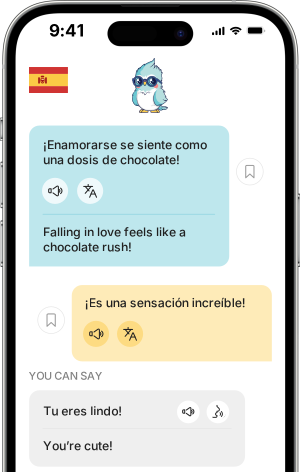
Real-Life Conversations With AI Language Tutor

Download on the App Store